Saturday, 12 September 2015

The Human Evolution Zoo Trip


Year 13 Bio has been learning about Human Evolution for the last 2 weeks; as you can see below, Mokani has been receiving encouragement and support in his learning from Bones aka the freshly renamed "Sally the Skelly"


On Thursday last week we attended the Auckland Zoo Trends in Human Evolution session. This began by students comparing the skulls of a human, chimpanzee and gorilla. 

Key vocab about the skull differences included:
Foramen magnum
Zygomatic arches
Sagital crest
Nuchal crest
Masseter muscles (chewing muscles)
Brow ridges
Parallel (hominid) or parabolic (human) jaws and teeth
Protruding jaws
Canine teeth for aggression or not


Next, in pairs or threes students were given 2-3 skulls and asked to work out which was the most primitive, and which was the most recent, using what they had just learned from the compare-contrast activity.


Sela and Siale making friends with their skulls


Mokani and John looking at the zygomatic arches (cheek bones)


Rapture thinking about her skull.. 


Our student teacher Miss Graaf sharing her knowledge with the boys.


Then we compared the full skeletons of humans and gorillas, which from top-down included:
shoulder joints,
shoulder blades, 
rib cages,
spinal shape,
arm length, 
wrist joints,
palm length,
finger curve or not,
thumbs and grips (precision grip for humans),
pelvis shape,
gluteus maximus attachments and size
valgus angle,
leg length,
ankle joints,
grasping big toes or straight big toes,
arches in feet

The next activity was to bring all the skulls to the table and try to work out their order overall. This also included working out which skull was Ardi and which one was Lucy!  Turns out that Lucy also had a male friend with her, showing sexual dimorphism as his skull was significantly larger than her own. 

We found out that the main pattern that has developed over time is an increase in cranial capacity (cc), or brain size in comparison to body size. Species in the Homo genus have much larger brains for their size, and humans in particular have a large forehead with room for a frontal lobe. We know what frontal lobes are responsible for because of Phineas Gage's injury with a tamping iron... Having a larger brain allows for more complex behaviours, planning, problem solving, and communication. 


Then we moved on to tools! Everyone was given a bag with a replica tool inside of it, and asked to put their hand inside and imagine how to hold it, whether there was a comfortable way, what it might be used for.. then we took them out, looked at them, and grouped them:


Oldowan tools are associated with Homo habilis (aka Handy Man) and are also called Pebble tools. They are basically the core of a rock shaped by a few blows to have a sharp edge. They were mostly used for smashing or crushing. 


Archeulean tools have a typical teardrop shape. They are kind of like the swiss army knife of tools - they can be used for smashing, crushing, throwing, stabbing, slicing, as a hand axe etc. The core of the rock is still the main tool. These teardrop Acheulean tools remained fairly unchanged for 1 million years! 

1.5 million years ago (mya) if you were holding this Acheulean tool, you were holding the most sophisticated technology on the planet. 


Mousterian tools were less generalised and more specialised for different jobs like slicing, cutting, spear heads, hand axes, etc. They are usually made from flint. They were often made from the flakes that come off the core, and require a lot more planning to make.


We concluded our trip with a wet walk around the zoo in the rain for an hour. We got to see a baby giraffe, the new Auckland elephant, 2 sleepy lionesses, a curious meerkat who came and said hi, a red panda doing laps up and down a tree and John holding a convincing conversation with a flamingo. 


In other news, Tamaki College may be getting some of our own ancient skulls from +Karen Ferguson and her awesome 3D printer! Different African fossils can be downloaded from this website, if anyone else has a 3D printer at their school :)


1104 Learns about Density

We've started a new topic for 4 credits at the end of Term 3! And depending on how hard we work, we could even do ANOTHER 4 credits in Term 4! On Thursday we started looking at different types of metals, making observations, and we weighed 1 cm cubed samples of them. 


Then yesterday we graphed their density (g/cm3) before learning what density actually is - the amount of particles packed into a given area. Objects or liquids that are more dense have more particles packed into the same volume.

First we watched this video.

Next I revealed to students the list of the liquids available to them and gave them each a piece of paper with two blank test-tubes drawn on it. Students got to draft a density tower that they thought would be most accurate, and then have a second guess by drawing a second test tube with some of the orders of liquids changed around.


The liquids we used were:
water (pink food colouring)
dishwashing liquid (green)
olive oil (yellow)
conditioner (white)
water + corn starch (bright red, lots of food colouring)
golden syrup (golden)
shampoo (white)
soy sauce (brown)
sunscreen (white)
baby shampoo (yellow)


I quite liked this activity because there was a lot of discovery learning happening. I didn't know the exact order in advance, and there were a lot of questions being thrown around like "is soy sauce going to sink through water?" which I got to answer with "I don't know, go and get a test tube and find out  before you add it to your density tower." There was also some logical thinking happening, like when Duui decided that dishwashing liquid would be more dense than water because when he uses it at home it moves to the bottom of the sink, and Brandon had a think about oil spills and water. 

I discovered that soy sauce is more dense than dishwashing liquid, because it sank right through the dishwashing liquid in my tower and sat on top of the conditioner layer. 

Most students guessed that the golden syrup would be the most dense. 


Here are some photos from our class:

Mac, David and Duui gently adding the next layer to their beakers. 


Mac's first attempt


Students working and cleaning out their beakers after failed attempts. It was quite good to get it wrong and have a layer sink through, because then they knew to add it earlier as it was more dense.


My attempt.


Mac's best "scientist face" as he studies his density tower - many more layers this time!


I think that this lesson (messy, loud, and a little silly) was a good one to illustrate density. 

Next week we'll have to start thinking about why cars and planes might be best made from more or less dense metals.. hmm...  


Friday, 26 June 2015

Envirogroup Goes to Greenbay


On Monday four of the Tamaki College envirogroup leaders +Mano Abraham+Racheal Kaitu'u+Bobbigrace vili and +Lana Poila went out to Green Bay to see what the finished product of daylighting a stream looks like.


We met with Konrad Heinemann, Tom Mansell and Josephine Bartley. Konrad and Tom were there to explain the process of daylighting a stream, while Josephine was there to learn like us.

Why was this trip so important? What does a stream in Green Bay have to do with the students and staff of Tamaki College? And why were Auckland Council engineers and project managers eager to take time out of their day to speak to us!?


The reason is that a similar project is now underway at Tamaki College! We have a pipe just like the one in the picture above running under our rugby fields, from under the library out to the reserve past the Rec. 


However, with all the development and new building happening in Glen Innes, Auckland Council has decided now is a good time to remove the stream from it's concrete prison and return it to a more natural state. 

There are lots of things that need to be considered; run-off, flow rates, water quality, fish passage, engineering considerations, 10-year flooding events, the stream ecosystem, preschool childrens' access and safety, Tamaki College security and aesthetics, council budgets, community interests...

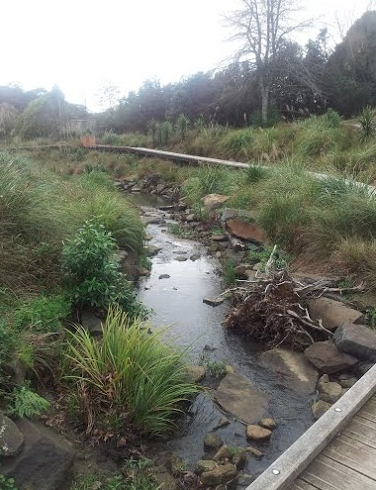
The picture above shows the final product of the La Rosa daylighted stream; every rock and plant and tree stump was purposely placed. This will eventually be what the Tamaki College stream might look like - with a little less water!


This picture showed the middle stage of construction, revealing the pipe - and what it looks like now.


Together we all went for a walk around the park, following the stream as it meandered through the natural dips that had been slightly enhanced... we walked past this particular section and could see what stream daylighting engineering technology used to look like - some rocks held in place by chicken wire! Auckland Council has refined their technique since then...


This is an outdoor classroom at La Rosa, and Tamaki College is lucky enough to be getting their own outdoor classroom too! Again, different considerations need to be balanced; the cost of building by Auckland Council, the design selection, how much our students can be involved in the construction (e.g. carving, trades, woodwork, earthworks), the cost of maintenance after Council hands over ownership to the school, etc.

The Council were proud of this particular outdoor classroom design at La Rosa because it gets people down to the stream and interacting with the water. Safety does need to be considered, but I guess you can't wrap everyone in cotton wool! I think overall they made the right choice, because there is a bridge to the left that can also be used to cross the stream but apparently all the students and community members walk down the banks and cross the stream using the stones! 


At La Rosa the Council also planted an orchard but the community nearby quickly took over to maintain it. Preschool children have painted the signs to label each of the trees, and a worm farm/compost was being run as well to fertilise the plants. The Council was even told to back away from the project because the community had it all under control! Our Tamaki students were most excited by the orchard as well, I think.


This is a 'before' picture held up to the view now. Again, every tree trunk and rock were deliberately placed to create riffles and oxygenate the water, or provide shade or shelter for invertebrates, eels, etc. 


This was another picture of the stream now, I think it's such a pretty picture it could even be a wallpaper for my laptop!


We finished our loop around with the stream at a covered sign, which the Auckland Council boys were kind enough to give us a sneak-peak at!

This photo shows the soon-to-be-unveiled signage created by the community about the daylighting project and stream ecosystem. It is made of a repurposed section of the original pipe that the stream was held in! What a cool example of recycling and community engagement - the artwork on the sign came from them as well :) 

Each of the envirogroup members came up with ideas that they would like to incorporate into the project - these can be added to all the ideas they got from Green Jam at Macleans College last week! 

The next Envirogroup Meeting will be jam-packed with ideas and discussion :) 

Feel free to come along and join us on Thursdays at lunchtime in the Whare Kai - pizza occasionally provided :P 

Tuesday, 9 June 2015

Year 13's go to Liggins

Last week I bundled up eight of my nine Year 13's and took them off to the Liggins Institute up at Grafton Campus in Auckland. They run a fantastic programme that allows students' the opportunity to learn about a number of topics and gain some hands-on practical science lab experience. 

The topic that we were learning about was the importance of a Healthy Start to Life, and how the environment of a foetus can affect what it looks like, it's birthweight and it's health throughout life.

One thing that I particularly remember is being stumped about why 10 little cloned calves who were all genetically identical actually looked different from one another.. (?!?)  I was sitting at the back of the room thinking.. "maybe birth order has affected how many nutrients they have access too.. maybe they have been kept in different paddocks with different food sources.." I didn't even think about the intrauterine environment, from having different surrogate mothers!

It turns out that the environment we all experience inside of our mothers' uterus may have a big influence on the rest of our life, especially during middle-age! 


After morning tea the students got to have a go using a micropipette and setting up a DNA sample for PCR. They mixed and mingled into groups with other students from Edgewater College and Onewhero Area School and worked really well together.

Chandar Dewan demonstrating how to use a micropipette

Sela and Kellie with girls from the other two schools

John concentrating on delivering the right amount of polymerase to the PCR tube

Siale and Rapture looking like they're enjoying the day :)


After students had set up their tubes to be taken away and have the sample copied billions and billions of times, the next thing to do was run gel electrophoresis on different samples of DNA, to work out how long the chain of base pairs were in each sample. If a sample has more base pairs then it is longer and bigger, and will push more slowly through the gel. If the sample has less then it will move more quickly and therefore get further through the gel! Then students could use a pre-set ladder sample to work out how long each one was, using a computer programme. 

Norman all ready to run gel electrophoresis


At the end of the day everybody split into two groups to talk to two scientists. One was still a student working on his masters about nutrition, and students enjoyed asking him what sort of protein is found in Up and Go (soy) and what protein is better to take when working out (whey right before, and casein the night before). 


Mokani and John ready to ask a neuroscientist some questions

The other scientist was a neuroscientist working on Alzheimers and Parkinsons disease, and he brought a real brain with him for students to have a look at, touch and feel! It was covered in a resin to keep it from degrading, so the brain was quite hard and a little bit plastic-y feeling, but so interesting!

Sela, Kellie and Siale touching the brain of a 60-year old!

Siale and Kellie touching a REAL BRAIN!!!

Year 13 Biology made me so proud on the field trip. They displayed respect towards Chandar, the students from other school and each other, and everyone had integrity and responsibility while they participated with their groups during the activities of the day. 

To celebrate their success Mr Kettle and I treated them to some ice-creams and McDonalds fries on the way home. Keep up the great work team! :)

+Rapture Iosefa +Sela Tukuafu +Sialemoka Kuki-Lagatule +Jay Akau'ola-Laula +Mokani Glassie +Norman Fogavai +Keletiola Mapa +Kitana Tutu-Inamata

Friday, 29 May 2015

Year 12 Makes Vocab Keychains

Vocabulary is such a big part of biology, it's almost like having to learn another language sometimes! 

Often in exam answers certain key-words have to be included, or students will have to understand a key word in a question to be able to answer! 

Our Tamaki College Specialist Classroom Teacher suggested taking a tactile approach to learning vocabulary, so I decided to get Year 12 biology to make their own vocabulary keychains.


First, students picked which vocabulary they would like to include on their keychain from these sheets:

Photosynthesis organelle structure - chloroplasts
Photosynthesis
Factors limiting photosynthesis
DNA replication


Then they cut them out, folded them, and whipped off down to the office to laminate them with Helen.


 When they came back students hole punched and attached each keyword and it's definition to a keychain.


Then we had 10 minutes SSR becoming familiar with their keychain, flipping back and forward between words and definitons.

Students can take them away and look at them over the weekend, or attach them to their keys and keep them until the real exams at the end of the year!


These are a more tactile version of the online vocab sets found in our 12BIO quizlet class :)


Wednesday, 27 May 2015

Year 12 Makes DNA

Year 12 Bio have been working like absolutely superstars towards their upcoming practice NCEA exam. We have finally covered all of the content (there was a LOT!) and now they are ready to revise and refresh.

On Monday and Tuesday we made lolly models of DNA, and then used them again to demonstrate DNA replication. It seemed to work quite well, and I hope the class enjoyed getting in there and making the models for themselves. 

We used liquorice as the 'sugar' part of the backbone, and added marshmallows as the 'phosphate' - that was the best that we could do for the backbone of the double helix! 

Then we added wine gums as the four bases, making sure to only pick 4 colours of wine gums and only pair them with their 'complimentary base pair.' 


Here's an example of the finished product. :) 

My next post will be some top tips for how to study and revise for exams, both online and off! 

Girls Rugby against Avondale

On Monday I drove the Tamaki College girls first XV to Avondale College, to play a hard-hitting, hard-fought game in the most atrocious weather I have stood in for a long time!

My feet were wet, my toes were numb, the rain was horizontal... I can't imagine how the girls were feeling running around on the field! 


They played with a lot of spirit and I loved their half-time cheer of "SISTERS!"but unfortunately this day the girls were not able to come away with the victory. 


I think my personal highlight of the match was seeing Ripeka chase down an Avondale player as she broke through the girls' line... the girl was sprinting towards the line, aiming to score under the post and Ripeka was thundering after her, catching up... it looked like there was no way to save the try, but Ripeka grabbed her shoulders and tackled her to the ground, twisting her in the tackle to hold the ball up and save the try! What a tackle!