Showing posts with label Kiwi. Show all posts

Sunday, 31 August 2014

Tamaki College goes to the Science Fair


On Friday 29th August I had the privilege of transporting 9KEm to their Science Fair competition at Fickling Convention Centre in Three Kings.

Students had spent weeks planning, preparing, collecting data, analysing, concluding, printing and pasting to get their projects finished in time for the school science fair.

Ms Smallwood held this in S3 last Friday, and students were able to practice their interview skills as some guest judges walked around, asked them about their projects and gave them some feedback. 

All of the projects had such creative names and they were all so different, the guest judges were all very impressed. Some of the projects included finding out which type of bowl degraded the fastest (interestingly, not the one called the 'biodegradable' bowl!), which type of bowl helped whisk egg whites the fastest and the highest, which fertiliser helped plants grow the tallest, which genre of music caused bacteria to grow the most, whether texting affected finger dexterity and which soil is most affected by liquefaction?

However, even after their practice the week before some students were still nervous on the way to meet with the real judges - "excitedly nervous," as one of them put it. Would the real judges ask them even harder questions? Would they like their ideas? 

Watch the video below to find out from students as they return from the judging room:


A big huge thank you to Ms Smallwood from all the Science staff and all the students! Ms Smallwood single-handedly organised the science fair students and projects at Tamaki College. Thanks for all of your hard work and extra after-school efforts! 

Finally, in breaking news, it appears that the dedication of Ms Smallwood and her science stars has paid off! Hopefully the science fair students have been checking their results on this website - but I will leave it to Ms Smallwood to announce on Monday. Congratulations Tamaki winners!

Friday, 25 July 2014

A Student Shines at the Halfway Point

Yesterday I set 9PLa and 9RTd an assessment as we are now halfway through the Chemical Reactions unit. 

Students chose whether they would like to work on paper, Google Presentations, Wix websites or Prezi. Most students chose to make a Google Presentation or Prezi, 2 students chose Wix websites and there are a few working on posters.

I set out Achieved, Merit and Excellence criteria, and students chose which grade they would like to aim for and got to work!

One student went home and kept working on their project, and here are some screenshots of her beautiful presentation, handed in days early and to a very high standard! Check them out below:


Here is the Achievement Criteria; what is the highest grade she met all the criteria for?

Achieved
  1. Include a safety slide at the start of your prezi. It must have information about:
    1. safety around acids and
    2. safety around bunsen burners.
  2. Include a slide with a definition of a chemical reaction. This slide must:
    1. be written in your own words
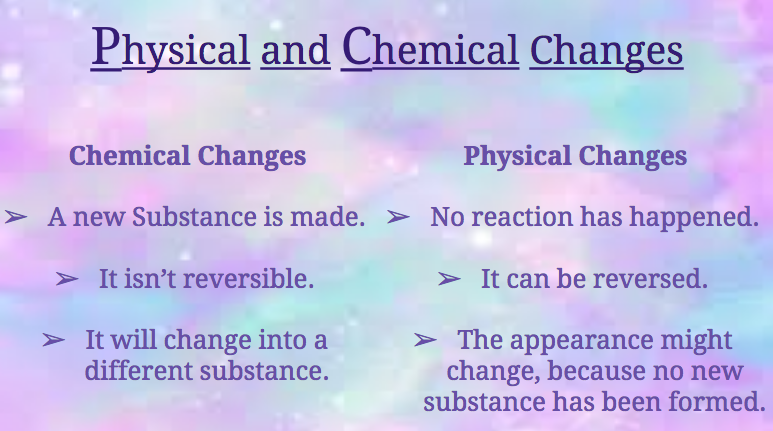
  3. Include a slide that explains the difference between physical and chemical changes. This slide must include:
    1. Whether or not a new substance is made
    2. Whether or not the change is reversible
    3. What you might observe (see) during a chemical change
    4. What you might observe (see) during a physical change
  4. Include a slide about 2 chemical reactions we have done at class, or others you do all the time at home.
    1. You may or may not want to include photos or videos from class
  5. Include a slide about the chemical change that happens when a potato is cooked
    1. Identify the reactants and the products

Merit
  1. Same as Achieved
  2. Same as Achieved
  3. Same as Achieved
  4. Include a slide about 2 chemical reactions we have done at class, or others you do all the time at home.
    1. You may or may not want to include photos or videos from class
    2. Explain how you knew they were chemical or physical
  5. Include a slide about the chemical change that happens when a potato is cooked
    1. Identify the reactants and the products
    2. Explain how you tested whether there had been a chemical change

Excellence
  1. Same as Achieved
  2. Same as Achieved
  3. Same as Achieved
  4. Include a slide about three chemical reactions we have done at class, or others you do all the time at home.
    1. You may or may not want to include photos or videos from class
    2. Explain how you knew they were chemical or physical
  5. Include a slide about the chemical change that happens when a potato is cooked
    1. Identify the reactants and the products
    2. Explain how you tested whether there had been a chemical change
  6. Include a slide about the chemical reaction between iodine and starch
    1. Identify the reactants and the products
    2. Explain what is happening during the reaction
    3. Discuss how you could use iodine to test another food; write a hypothesis of what you think would happen and a method of how you would test it.  

Thursday, 24 April 2014

Tamaki College Heist

Last Wednesday Tamaki College were visited by the The Royal Family - no not Kate and Wills (although that would have also been very cool) - the Hip Hop Dance Crew! The performance was amazing to watch and the kids looooved it! 

All the credit goes to Jake in Year 13 for organising the campaign and motivating the entire school to participate in the MaiFM competition. 

I can't embed the video but follow the link to watch it here


Wednesday, 23 April 2014

Rotoroa Island Sanctuary

At the end of Term 1 the Year 12 and 13 biology students from Tamaki College were lucky enough to go on a field trip to Rotoroa Island. 


This amazing island used to be a drug and alcohol rehabilitation centre, but nowadays it is a newly established conservation site for native New Zealand wildlife. Read on to find out what the trip had in store for our students!


Students enjoyed the ferry trip over, especially using binoculars to look at gulls and blue penguins (korora) and working together to recreate that iconic scene from Titanic... Thankfully the ferry didn't meet the same fate as the Titanic, and we were able to get our first glimpse of the island. 


Once we were all on Rotoroa students walked to the 1860's schoolhouse - the road provided a really nice view of the island we would spend our day exploring! Our guide Greg then gave an honest talk about the realities of keeping Rotoroa pest-free. Students learned about the many different ways to trap and humanely kill possums, stoats, rats and weasels that can reach the island. 


Once the talk had finished, Greg produced some possum, stoat and ferret skins.  At first the students were grossed-out but then curiosity prevailed! They enjoyed taking selfies with the skins, passing them to each other and asking Greg lots of questions. After the talk 5 students said they would be happy to come and share what they learned about pest control with some of my Year 9 classes!


After morning tea we split into two groups and off we went to help Greg with some research. Students took turns setting up simple tubes with banana and pieces of paper that had a strip of ink down the middle. The banana tempts animals into the tube and the ink ensures animals leave prints all over the paper as they walk. Researchers can then use their knowledge of prints to tell which animal it was, whether it is a pest, and whether they should lay traps. Greg also showed us how watery gum from Harakeke flax can act as a natural second-skin to help heal burns and eczema. 


We then did a lot of walking (including up a huge hill) with Greg stopping along the way to show us different traps, a huge weta, traditional Maori plant uses, how to use a tracking radio, and letting students use tablets to help identify different animal prints. 


After lunch students got to use the radio tracker to find soft-toy animals that had transmitters on them (the toys had to be hidden off the ground or the cheeky Weka would have run off with them), practice banding bird-legs and using binoculars to read band patterns from a distance. 


It was a big day - lots of sun, lots of walking, lots of learning - and quite a few of the students fell asleep on the way home! I hope they enjoyed themselves as much as I did and are looking forward to their next trip to Tiritiri Matangi!