Showing posts with label Year 9. Show all posts

Thursday, 12 April 2018

Rocket Launches with 9TGn

This term I've been teaching Third Rock to my Year 9 class. It's a thematic unit that combines learning about tectonic plates, convection, earthquakes, volcanoes, energy changes, rocket launches, speed distance time calculations, investigations, life on Mars, seasons and all kinds of things! 

I've been twiddling it as we go through based on the class in front of me, and due to the school-wide (and cluster-wide) goal of improving the literacy of all of our students. There's been lots of pair and group reading and discussing, story-writing and blogging which has actually been really enjoyable for me to learn about and design for them, and they seemed to increasingly enjoy engaging with it. 

Last week we had a wee cross-curricular sequence. I was absent for the first part where students were supposed to read their first scientific fact-sheet kind of text (our other texts have been stories, articles, methods and reports) about types of energy.

Because the end of term was rapidly approaching (and Y9 camp too!) I didn't have time to catch them up on my return, so instead they continued over to graphics the next day and built their rockets with Ms Fergusson and then the next day we launched them on the field with Mr Dunn! 


Here is a student's perspective of the rocket launch on their blog :) 

I tried to have a few quick chats about the different forms of energy while we were on the field watching each group's launch, and during our next lesson we did some more on energy changes and they completed the activity identifying energy changes in our school Kapa Haka performance (that they should have completed the day I was absent!)


For a Do Now during the review lesson I created a word-find after a request from the students. Word-finds are not very useful for learning, I think, unless maaaaybe for the spelling of words. So instead of giving them a list of words to find I changed it so they could approach the learning in two ways: 

1) go looking for familiar words in the word-find and then match what they found to the appropriate definition OR 
2) identify what word they should be looking for based on the definition and THEN look for it in the word-find.


Click here for a link to the word-find.

Wednesday, 18 March 2015

Hotspot Animations

Today in our double period 9KMn made play-doh animations of Auckland's volcanic hotspot.

Auckland sits above a hotspot of magma, about 100km under our feet. 

A hotspot is an extremely hot area bordering the crust and the mantle, where temperatures are so high they melt the surrounding rock. There is a plume of hot rock rising out of the mantle as part of the mantles' constantly moving convection currents. It melts the rock and rises through the crust. It forces its way up to the surface and erupts to form a new volcano in Auckland.


How we made animations

Students used play-doh to create the crust, the hotspot, show rock melting, and showing the magma moving up through the crust to erupt at the surface. 

They set up the initial scence and took a photo using their Chromebooks. 

Then students moved the playdoh slightly, acting out what happens in the hotspot under Auckland. After each tiny movement another photo was taken.

One student got the job of adding each individual photo (one group took 51 photos!) to it's own Google Presentation slide. When the presentation is shared to the internet and plays automatically, it looks like a stop-motion animation! 

The final step was to add a few slides at the end of the animation for each student in the group to explain what their animation showed. The student who had added the photos to the presentation shared it to the other students in the group with full editing rights, and students were able to add their paragraph all at the same time (using their own words of course)


Students share their creations

Autymn, Nathan, Paris and Dante made an animation and Auymn posted about it on her blog here.

Please go and leave Autymn's group a comment about what you liked, learned or even what they could improve on next time we make stop-motion animations! 

Wednesday, 11 March 2015

9KMn Blogs about Alfred Wegener and Continental Drift!

9KMn's blogs are finally up and running, and their first post is about continental drift!


We started the Third Rock From The Sun topic by learning about the layers of the Earth, how the crust is divided up into plates, and how convection currents in the mantle cause sea floor spreading which leads to continental drift.


Students absolutely loved watching the video below at the start of the unit. They convinced me to play it about four times in one lesson!


 After a few days 9KMn was able to understand who all the characters were and what they were talking about when rapping "cut em' out the book notice their shape, they're fitting pretty well there I dare say" and "hey it's Harry Hess and it's after the war, I'm using sonar to map the sea floor."


After a few activities in class such as the classic jigsaw and evidence cut-out for Pangaea, as well as looking at whether certain things count as scientific evidence or not, and looking at Pangaea break-up simulations here and here, students were ready to create and share their new understanding.


They chose what style of creation they would prefer to do. These included a piktochart newspaper article, filming an interview, different styles of writing, creating and performing a rap, or using GOanimate, or Prezi! These links will take you to the criteria students were working off while making their creations.


Some students have finished their creation and included them in their first blog post, while others are still editing and will add them soon! 


Click on their names to see completed blog posts from superstars TalitaAntonioAnamanu,  Phoenix, and PJ.


Thursday, 29 January 2015

New Year 9's - 9TSt

Today the 2015 Tamaki College Year 9's arrived, and I got to meet the new Totara recruits.


9TSt doesn't know it yet but I'm their science teacher twice a week! I'm looking forward to meeting them properly on Monday morning, period 1. 

They seem like a lovely bunch, and it looked like they were having fun with the icebreaker games, lead by our Year 13 student leaders.


Some of the games they played were:

~ Song Battles

Teams were all given the same word (love, boys or girls, and colours) and had to compete against one another to remember and sing snippets of as many songs with those words in them as possible (e.g. for 'colours' one team sang 'black and yellow black and yellow...')

~ Bang

Standing in a circle students quickly had to learn the names of the people around them, because whoever had their name called had to quickly duck, while the people on either side had to shoot across their head as fast as possible, to shoot the other person before the other person shot them!  

~ Straight-Faced Compliments

Two people faced each other while everyone lined up behind them. Then the two people had to compliment one another without laughing! Lots of people were complimented on their hair, their teeth, their... nostrils!?

Monday, 25 August 2014

Students Are So GOOD With Technology!

During the Chemical Reactions unit 9PLa demonstrated once again how capable they are with technology. They have used it in many different ways to share their understanding!

This is a Prezi made by Viola


Students in 9PLa also all made their own websites - I am not sure the general public will have permission to see them though.  If you click on the screenshot of the website below, you will hopefully be taken to a students' site and be able to see all their work, explanations, videos and the Do Now's they created for others.


If the picture doesn't link to Gustavo's site, click here
If that doesn't work, then you don't have permission to view it. 


One student in 9RTd even filmed their own video during the unit, edited it and added a great backing track - a rap about safety in science! Thanks Ricky.


As always, follow this link to see the gorgeous work my three Year 9 classes have been creating, and feel free to explore my site :) 

Sunday, 24 August 2014

Making Ice-Cream - Easy!

All three of my Year 9 classes finished their Chemical Reactions unit on Friday, and we decided it was time for a treat for working so hard!

9PLa and 9PTt got to make ice-cream after Latiume sent me this link and requested to make ice-cream, and 9RTd got to launch rockets with Mr Grace in their Friday class!

I was so impressed by how 9PLa and 9PTt worked together to help set up their bags of ice-cream, which you can clearly see in the photos below. The recipe for ice-cream is not difficult, and some of the students even said they would make it at home again!

Everybody helping one another with the measurements - it is difficult to do alone!

Trey helping Lasa measure the vanilla essence.

Everyone doing the measurements.

Once the two bags were all set up students had to keep shaking them to make their ice-cream creamy!

Suzie enjoying her ice-cream in the sun.

Latiume and Tyrone were pretty happy with the outcome of their effort.


Reactants for the small ziplock bag:
1/2 cup blue milk
2 tablespoons of sugar
1 teaspoon of vanilla essence

Reactants for the larger ziplock bag:
Three handfuls of ice
1/4 cup rock salt

Method:
1.   Place all of the reactants for the small ziplock bag into it.
2.    Make sure the small ziplock bag is COMPLETELY sealed.
3.  Place all of the reactants for the larger ziplock bag into it.
4.  Place the smaller ziplock bag into the larger bag. 
5. Shake the larger bag from the corners, try not to touch the ice too much - it's very cold!
6.  Shake until you can feel the milk has hardened into an ice-cream-like texture.

Product:
Vanilla Ice Cream

Word Equation:
milk+sugar+vanilla essence --> vanilla ice-cream

Conclusion:
The science behind this chemical reaction is that mixing ice and salt causes the ice to be able to melt into water while it is still at the temperature of ice - below 0 degrees. Try not to touch the freezing cold ice-water while shaking the bag, as it can cause second or third-degree burns similar to frostbite. The ice-cream tasted really nice, but some bags had a slight salty taste because there was some salty water sitting in the crease of the ziplock bag, which fell into the ice-cream when it was opened! 9PLa would advise you to wash the bag before opening it, while I quite enjoyed the slightly salty ice-creamy taste; kind of like salted caramel. Yum!

Friday, 25 July 2014

A Student Shines at the Halfway Point

Yesterday I set 9PLa and 9RTd an assessment as we are now halfway through the Chemical Reactions unit. 

Students chose whether they would like to work on paper, Google Presentations, Wix websites or Prezi. Most students chose to make a Google Presentation or Prezi, 2 students chose Wix websites and there are a few working on posters.

I set out Achieved, Merit and Excellence criteria, and students chose which grade they would like to aim for and got to work!

One student went home and kept working on their project, and here are some screenshots of her beautiful presentation, handed in days early and to a very high standard! Check them out below:


Here is the Achievement Criteria; what is the highest grade she met all the criteria for?

Achieved
  1. Include a safety slide at the start of your prezi. It must have information about:
    1. safety around acids and
    2. safety around bunsen burners.
  2. Include a slide with a definition of a chemical reaction. This slide must:
    1. be written in your own words
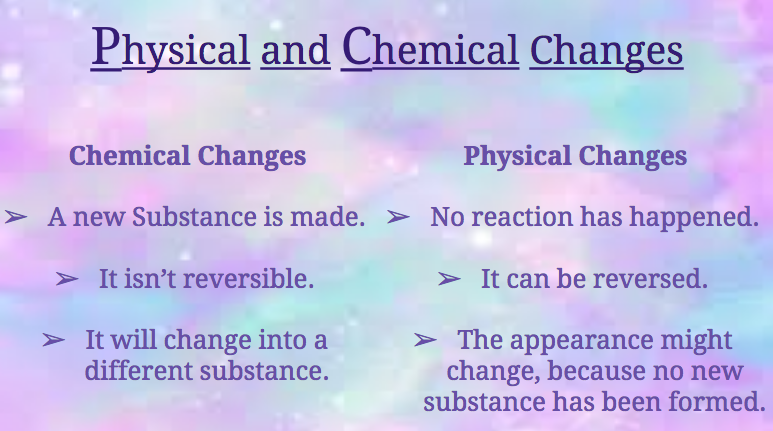
  3. Include a slide that explains the difference between physical and chemical changes. This slide must include:
    1. Whether or not a new substance is made
    2. Whether or not the change is reversible
    3. What you might observe (see) during a chemical change
    4. What you might observe (see) during a physical change
  4. Include a slide about 2 chemical reactions we have done at class, or others you do all the time at home.
    1. You may or may not want to include photos or videos from class
  5. Include a slide about the chemical change that happens when a potato is cooked
    1. Identify the reactants and the products

Merit
  1. Same as Achieved
  2. Same as Achieved
  3. Same as Achieved
  4. Include a slide about 2 chemical reactions we have done at class, or others you do all the time at home.
    1. You may or may not want to include photos or videos from class
    2. Explain how you knew they were chemical or physical
  5. Include a slide about the chemical change that happens when a potato is cooked
    1. Identify the reactants and the products
    2. Explain how you tested whether there had been a chemical change

Excellence
  1. Same as Achieved
  2. Same as Achieved
  3. Same as Achieved
  4. Include a slide about three chemical reactions we have done at class, or others you do all the time at home.
    1. You may or may not want to include photos or videos from class
    2. Explain how you knew they were chemical or physical
  5. Include a slide about the chemical change that happens when a potato is cooked
    1. Identify the reactants and the products
    2. Explain how you tested whether there had been a chemical change
  6. Include a slide about the chemical reaction between iodine and starch
    1. Identify the reactants and the products
    2. Explain what is happening during the reaction
    3. Discuss how you could use iodine to test another food; write a hypothesis of what you think would happen and a method of how you would test it.  

Wednesday, 25 June 2014

Year 9 Visits the Stardome

On Friday we took all of Year 9 off to Cornwall Park to visit the Stardome. 


Students got to walk to the top of the volcano and look around. Students weren't looking forward to the big walk up the hill, but there was a sense of achievement and success when they reached the top and were able to look around!   

We then returned to the Stardome for a show on the sky screen and a talk.  My group watched a show called 'Two Pieces of Glass' about the history of the telescope and how far it has developed with todays technology. It also taught us about the discoveries that telescopes have helped with.

This is a beautiful video of the night skies from a mountain in Spain for any students who were amazed by how big our universe is. 

After the show students got to explore the different activities in the foyer of the Stardome. There was a scale that measured their mass and calculated how much they would weigh on different planets and stars (billions of kgs on a neutron star!), real space suits and telescopes, a rolling-ball demonstration of gravity and a sphere that showed what the different planets look as they rotate, among other things. 

We then went and listened to a talk about how much fuel and speed space shuttles need to get up into outer space! One thing I remember is that at the very start of a space shuttle launch, by the time the back of the space ship has reached the point where the front of the space shuttle was (by the time it has travelled its own length) the shuttle is already travelling at 100km an hour! Students in my group were especially amazed to see a video by Chris Hadfield about how astronauts brush their teeth in space!  


We finished the day with some free time at lunch - I think the rugby game that happened on the field involved most of the boys in Year 9!


Wednesday, 11 June 2014

PTt Begins the Web of Life

Evon would like to share her experiences from the beginning of the Web of Life unit:


Know how to make a cup grass thing.
1 part: was to get a cup.
2 part: to get a stocking.
3: fill it with seed and next fill it with soil and after wet all did that we decorate the cup and dress it up.  
Each day one person had to water the grass. 

A few weeks late we wondered and the grass grown and we could cut the hair of the grass, make it it into a boy or a girl.

Day 1: Loa is the water monitor on this day. The grass has started to grow from the grass seeds!


Day 8: Siupeli and Phoenix are surprised how much the grass grew over the weekend.


Day 8: Cameron and Jonive investigate the rest of the critters' growth.


Day 12: Cameron cut his grass critter's hair very professionally!


Day 12: Loa is holding her grass critter with it's new haircut.


Day 12: The critters all look great after their haircuts!


Wednesday, 4 June 2014

Movies! Migration and Skeleton Teeth...

The Web of Unit life has come to a close, and it finished with students creating, creating, creating! Most of 9PLa decided to work in groups to create three videos (1 on migration, 1 on the teeth of herbivore, and 1 about marine food webs), while 2 boys chose to create a comic strip each. 

Comic strip about pests and native animals coming along...

Students wrote their own scripts, practiced, told me which props they would like, and then off they went to film! Some groups were totally independent while some others did need me to come and film for them. I was really impressed by them as this is the first time some of them have made movies, and definitely the first time I've let them take full control.

Script for the food web video in progress...

Scripts for all the actors and the list of props required...

I did the editing for 2/3 of the videos (we ran out of time - exams are coming next week and my learners need to start revising!) and because I have them on my laptop already, here they are! 

Watch them in order - the middle video is a trailer for the last video...

Tremayne interviews Austin the Migration Expert

A trailer for The Skeleton Mystery..

The movie: The Skeleton Mystery

Thursday, 29 May 2014

9RTd Creating...

Today 9RTd started on their 'create' week as well. Two groups chose to make a MRS C GREN video... 


Wednesday, 28 May 2014

Students Getting Creative

Year 9 classes 9PLa and 9RTd have reached the 'create' phase of the Web of Life unit! 

There are a lot of different creation activities students can choose from, covering a wide range of content with different styles of creation for students to express their understanding.

Clicking on the picture below will take you to the class Web of Life Creation page, where you can explore the different activities available to the students, check out the criteria students have to meet for each activity, and view the links students have shared of the work they have finished :) 


Two groups of students chose to make a video about MRS C GREN yesterday; two boys chose to make a video in the last 5 minutes of class after they made a poster about trophic levels!  Here is their final product:


Thursday, 22 May 2014

Science Roadshow comes to Tamaki College

The Science Roadshow (sponsored by the Ministry of Education) came to Tamaki College today. Year 9 classes each spent two periods playing with the exhibits, learning off the Year 10 guides, asking questions and watching two live demonstrations.

Just watch the video...


Tuesday, 20 May 2014

9PLa Making Food Webs

9PLa used these sets of cards to create a huge, complicated food web.

They worked in two teams and used the information on the back of each card to work out the relationships in the food web. There were arrows showing the flow of energy from prey to predator all over the place by the time they had finished!! 


If I was going to repeat this activity I would hand out a card to each student and make sure they know what their 'character' eats before letting them create the web. That way everyone will have information to contribute and involvement would be more equal. 

In the last 5 minutes of class I challenged 9PLa to see who could write down the most food chains based on the food web they had created. Then they posted their responses to me in the class postbox.  


One student was so keen to get the most chains that I agreed to photograph the food webs and email them to him - but I wrote this blog instead! I hope you can see all the different names in the pictures Tyrone - if not then you can open the cards here and make your own food web instead :) 


Friday, 16 May 2014

Awe-Inspiring Work by Year 9PLa

Year 9 has been learning about what makes living things alive, animal diets and adaptations that help living things survive. 

I have simultaneously been using the time to see how students learn during the Manaiakalani 'Learn,' which is a little passive but sometimes necessary to get content across. Students have listened, done research, watched videos, talked to each other, completed quizzes, played games, and commented on their learning. They have been keeping track of this in their Google Doc as a kind of learning log. 

However, students were getting a little bored with this. One brave student offered some quiet feedback to me and said there was "too much to learn" and we had been doing "too much writing," so we thought it would be a good idea to have a break from new content and 'Create' something that showed off how much they understood. Each student picked their favourite Mammal and set about creating a profile for them. 

We had some spectacular work produced. We let students choose what media they wanted to use to create... here is a freehand poster about Cats.


Most other students chose to use Google Presentations and two students chose to use Wix to create their own websites! 

Click the Garfield poster to be taken to all four great examples of student work, or click here to see a student-made site about lions, or here to learn about pandas from my class! 

Maybe I should try animation with this class of superstars one day soon... 


Tuesday, 13 May 2014

9PTt "Polluted Water" Puzzle

9PTt has been learning about separating mixtures and solutions using decanting, filtering and evaporating. There's only so much you can learn from listening to a teacher, so I decided to challenge them practically. 

I set up large beakers containing rocks, sand, salty water with blue food colouring and topped off the "polluted sample" with a layer of baby oil. Students had to work out how to separate the different parts of the sample to find out how much salt was in the water. 


Students decanted the salty liquid out of the beaker, leaving behind a heavy layer of rocks and sand. There was still some sand floating in the liquid, so students had to filter the liquid through a funnel and filter paper. 

Next students poured the salty liquid into a funnel while holding it closed with their thumb. They (mostly) waited patiently until all the oil rose to the top then let the water out from underneath, leaving the oil behind. 

I didn't quite trust that all the oil had been removed from the sample and didn't really feel like setting anything on fire today, so I collected back their samples and distributed a new one with only salt and water in it!


G opening the bunsen burner hole to get a blue flame

Students then evaporated off the water using an evaporating dish heated over a bunsen burner to find out how much salt was in the solution. There was a lot of engagement during this practical, and I feel that students benefitted a lot from being able to do the separation themselves.  

  Tomorrow the students are going to learn how to separate mixtures using chromatography and make some cool chromatography flowers while they're at it!


Wednesday, 19 March 2014

How long can 9PLa hold their breath?

Yesterday afternoon 9PLa had some fun learning to read stopwatches! 

Ms Bunce handed out the stopwatches and everyone quickly started playing with them. Two of the boys started to time how long they could hold their breath, so Ms Bunce quickly turned it into a whole-class competition.

Looking around the room I could see faces turning red and there were also students holding their hands in front of each others' nose and mouth to check that no one was cheating! 

You can check out the video from the class below. Unfortunately the real breath-holding competition had finished by the time I remembered I could film it, so this is a less-competitive repeat of the activity!


Thursday, 20 February 2014

Particles in Matter

I've been learning so many great digital tips and tricks during my Wednesday MDTA sessions. 

Here's a video that I made for my Year 9's using WeVideo.